General relativity from first principles
It’s been a ~lifelong goal of mine to understand general relativity. I still don’t. But I watched an incredible video of Adam Brown explaining GR to Dwarkesh Patel and something finally clicked, so this is my attempt to regurgitate that explanation in my own words.
The initial observation
It starts by noticing something suspicious about the following two formulas:
\[\begin{aligned} F &= ma \\ F &= G \frac{mM}{r^2} \end{aligned}\]They both use $m$. If Einstein were a 13-year-old today, he might say “That seems a little… suss”. (Side note: this is the equivalence principle – the fact that $m$ is the same in both formulas.)
Now, here’s the problem - you’re so used to this being true that you probably don’t view this as suspicious at all. You probably (correctly) view this as some sort of fundamental law of nature. If it weren’t true, that famous science experiment where you drop a bowling ball and a feather in a vacuum and they fall together would totally break down!
A flawed proof
In fact, I’m going to be mean and “prove” to you that this “must” be true (disclaimer: this proof is flawed). I’m going to explain why objects of different masses “must” fall at the same rate using Galileo’s “leaning tower of Pisa” thought experiment:
Assume that heavier objects fall faster than lighter objects. We have two objects A and B. A is heavier than B, so it falls faster.
Now we’re going to make a new “object” by connecting A and B with a very light string (light enough that we can ~ignore it). Let’s call the new combined object C.
C is heavier than either A or B, so it should fall faster than either. But what will really happen when we drop C? Well, A will fall faster than B and the string between them will eventually become taut. The tension on the string will be caused by B slowing down A, and A speeding up B. So the combined object will actually fall slower than A and faster than B.
But we started with the assumption that heavier objects fall faster than lighter objects and C is heavier than A. Contradiction! Therefore, objects must fall at the same rate, regardless of mass.
It’s quite compelling, isn’t it?
It didn’t have to be this way
In order to explain the flaw in the above proof, we’re going to work through the very same thought experiment, but instead of using the gravitational force, we’re going to use the electromagnetic force.
\[\begin{aligned} F &= ma \\ F &= k \frac{|qQ|}{r^2} \end{aligned}\]The formula for the electromagnetic force looks fairly similar to gravity, but notice that it doesn’t use $m$ at all. Of course it doesn’t, it has nothing to do with mass - it has to do with electric charge.
A (more obviously) flawed proof
Now I’m going to “prove” to you that objects with different charges “must” accelerate at the same rate (side note: this is false). See if you can spot the flaw and map it back onto the original thought experiment (which used gravity).
Assume that more-charged objects accelerate faster than less-charged objects. We have two objects A and B. A is more-charged than B, so it accelerates faster.
Now we’re going to make a new “object” by connecting A and B with an uncharged string. Let’s call the new combined object C.
C is even more-charged than either A or B, so it should accelerate faster than either. But what will really happen when we let C go? Well, A will accelerate faster than B and the string between them will eventually become taut. The tension on the string will be caused by B slowing down A, and A speeding up B. So the combined object will actually accelerate slower than A and faster than B.
But we started with the assumption that more-charged objects accelerate faster than less-charged objects and C is more-charged than A. Contradiction! Therefore, objects must accelerate at the same rate, regardless of charge.
But objects with different charges don’t accelerate at the same rate.
A worked example
Is the flaw obvious? In case it’s still not, let’s just work through an example.
- Object A is 1 kg and has a charge of +2 C
- Object B is 1 kg and has a charge of +1 C
Without loss of generality, let’s assume the wall(?) we are accelerating these toward has a charge of (minus) 10 C and it’s 1 meter away. Let’s solve for the acceleration of A:
\[\begin{aligned} m_a a_a &= k \frac{|q_a Q_{\text{wall}}|}{r^2} \\ 1 a_a &= k \frac{|2 \cdot 10|}{1^2} \\ a_a &= 20k \end{aligned}\]Now let’s solve for the acceleration of B:
\[\begin{aligned} m_b a_b &= k \frac{|q_b Q_{\text{wall}}|}{r^2} \\ 1 a_b &= k \frac{|1 \cdot 10|}{1^2} \\ a_b &= 10k \end{aligned}\]Last but not least, let’s solve for the acceleration of C:
\[\begin{aligned} m_c a_c &= k \frac{|q_c Q_{\text{wall}}|}{r^2} \\ 2 a_c &= k \frac{|3 \cdot 10|}{1^2} \\ a_c &= 15k \end{aligned}\]Ok, so the object C really does accelerate slower than A and faster than B. So what was the flaw in the “proof”?
The flaw in the proof
The only flaw was the very last sentence:
Therefore, objects must fall at the same rate, regardless of mass.
or
Therefore, objects must accelerate at the same rate, regardless of charge.
The proof starts by saying “Assume heavier objects fall faster than lighter objects”. It then derives a contradiction. This shows that acceleration is not determined solely by mass, but it does not prove that acceleration is unrelated to mass.
In the electromagnetic case, the proof starts by saying “Assume that more-charged objects accelerate faster than less-charged objects”. It then derives a contradiction. This shows that acceleration is not determined solely by charge, but it does not prove that acceleration is unrelated to charge.
What does determine acceleration in the electromagnetic case?
If you look at the math, the quantity that determines acceleration is the ratio of charge to mass ($\frac{q}{m}$). You can’t just compare the charges of A and B, notice A’s charge is larger and assume that means acceleration is also larger. You need to compare the ratios:
\[\begin{aligned} \frac{q_a}{m_a} &= \frac{2}{1} &= 2 \\ \frac{q_b}{m_b} &= \frac{1}{1} &= 1 \\ \frac{q_c}{m_c} &= \frac{3}{2} &= 1.5 \\ \end{aligned}\]Object C has the highest charge, but not the highest charge-to-mass ratio, so it doesn’t accelerate the fastest.
Back to gravity
We just demonstrated that Galileo’s thought experiment does not prove that acceleration is unrelated to mass. In other words, it does not prove that objects with different masses have to fall at exactly the same rate. But… they do right? So why?
Well, here’s an analogy: The electromagnetic force is to gravitational force as $\frac{q}{m}$ is to $\frac{m}{m}$. In other words, the correct “ratio” that determines acceleration due to gravity is $\frac{m}{m}$. Let’s compare this ratio for the objects A, B and C:
\[\begin{aligned} \frac{m_a}{m_a} &= \frac{1}{1} &= 1 \\ \frac{m_b}{m_b} &= \frac{1}{1} &= 1 \\ \frac{m_c}{m_c} &= \frac{2}{2} &= 1 \\ \end{aligned}\]They’re all the same (obviously). No matter what mass you plug in for $m$, it cancels out and the ratio is equal to one. So acceleration (due to gravity) does not depend on mass at all.
I want to hammer in the point that it really didn’t have to be this way! And in fact, it is not this way for other forces, like the electromagnetic force. Mass does not cancel out when you solve for acceleration due to the electromagnetic force.
You could imagine a logically-consistent parallel universe where the “gravitational charge” was not the same as the mass. The formulas would look like this
\[\begin{aligned} F &= ma \\ F &= G \frac{g_1g_2}{r^2} \end{aligned}\]And solving for acceleration would result in the ratio $\frac{g}{m}$ and this would feel just as natural as it does for electric charge.
Maybe it’s a clue…
Here’s where the genius of Einstein really kicked in. He noticed this suspicious coincidence and thought: maybe it’s a clue to some deeper truth about reality. Is there something about the universe that, if true, would force “gravitational charge” and mass to be the same?
Fictitious forces
This is going to seem like a total left turn, but I promise it’ll come back to where we started.
Do you remember back in high-school physics all those “force diagram” problems? Here’s an easy one: Consider the following force diagram and think about where the block will be in 1 second.
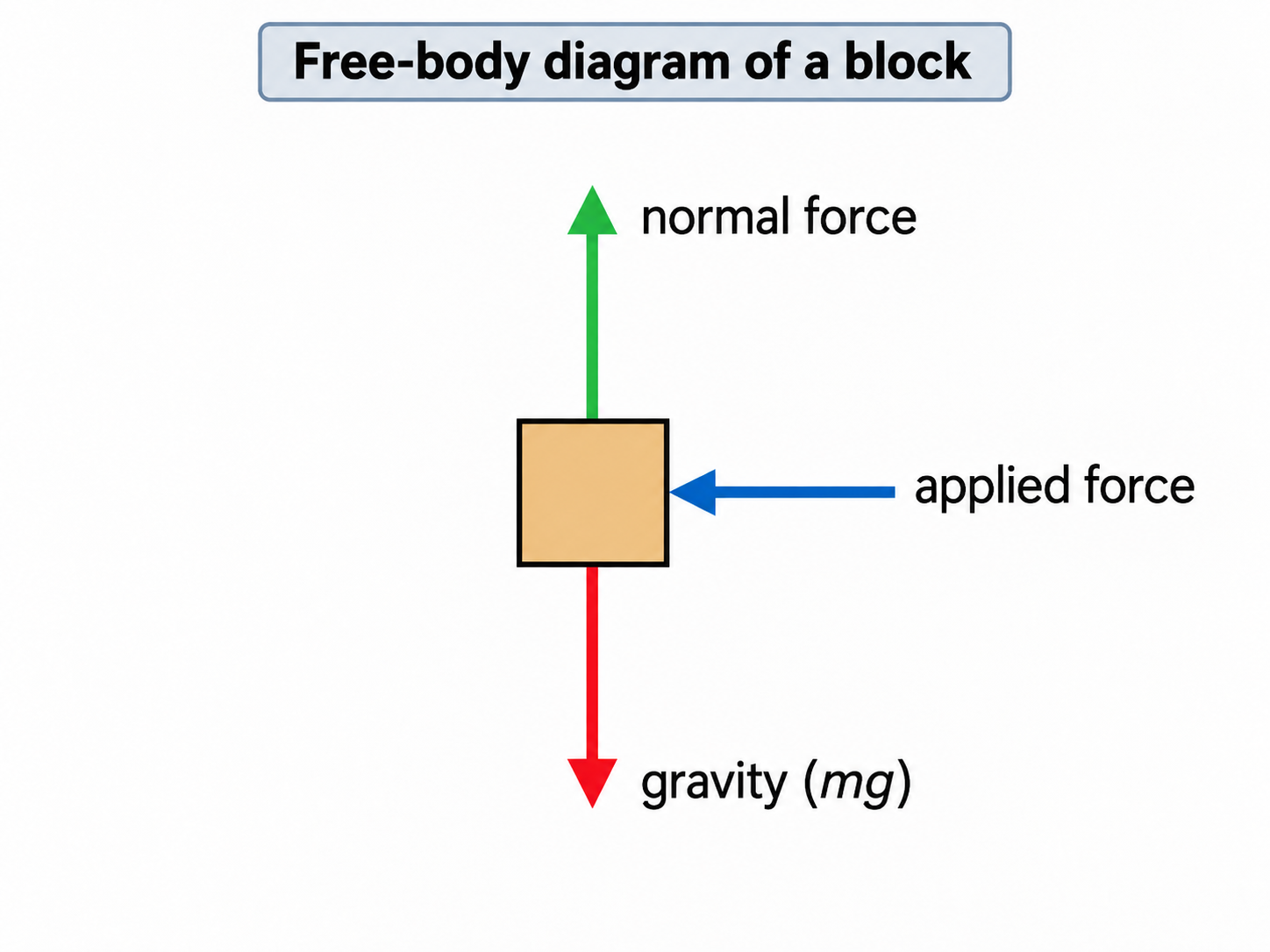
Hopefully you answered something like “somewhere to the left”. Since the block is pushed to the left and there is no force pushing in the opposite direction, the natural expectation is for this block to start accelerating to the left.
But this is a trick question. Now I tell you, actually the block is exactly where it started!
That seems wrong. What could possibly explain it?
One answer is: The diagram must be missing a force - actually there is a force pushing to the right. Something like this:
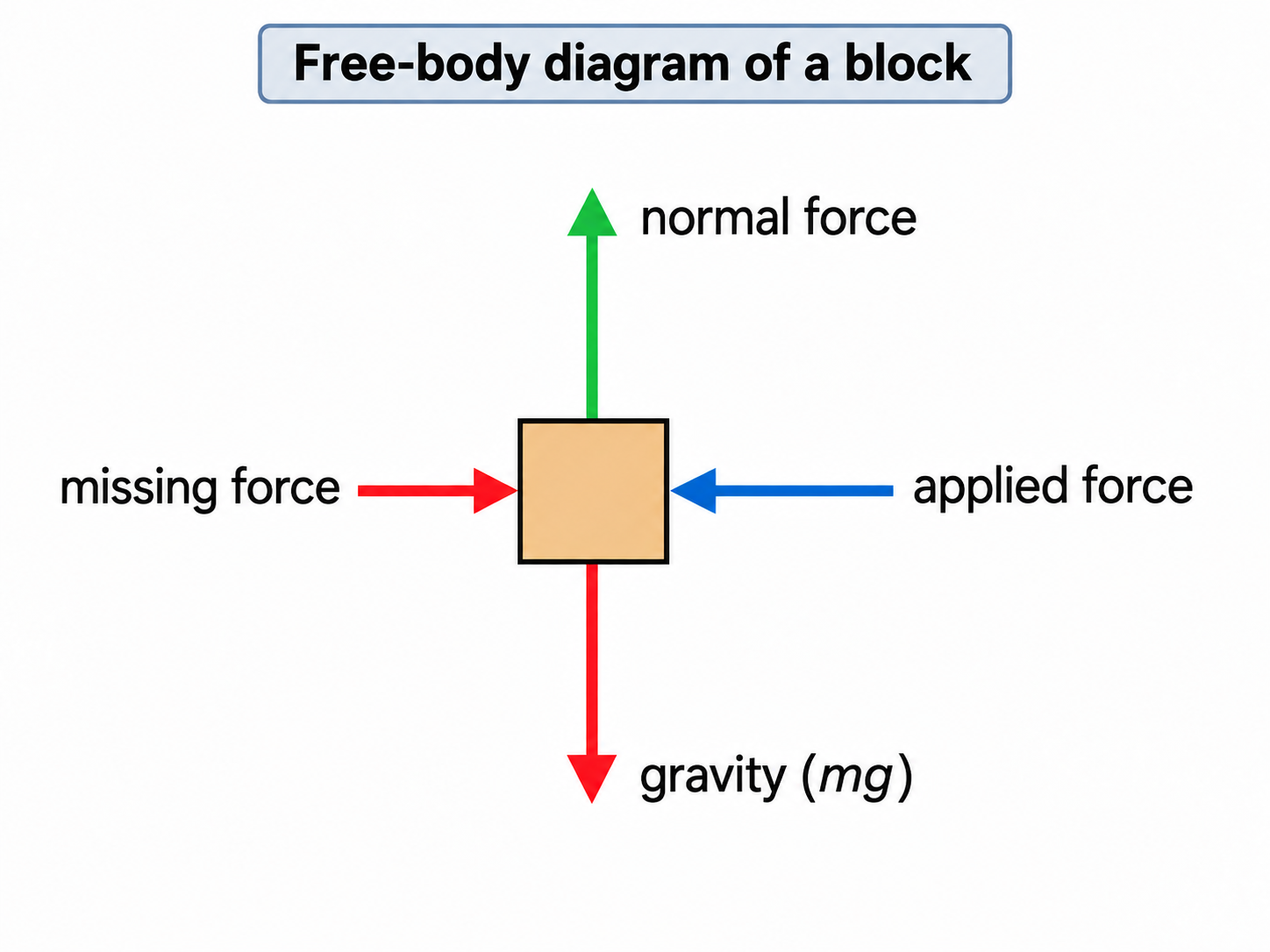
But here’s the real explanation I had in mind:
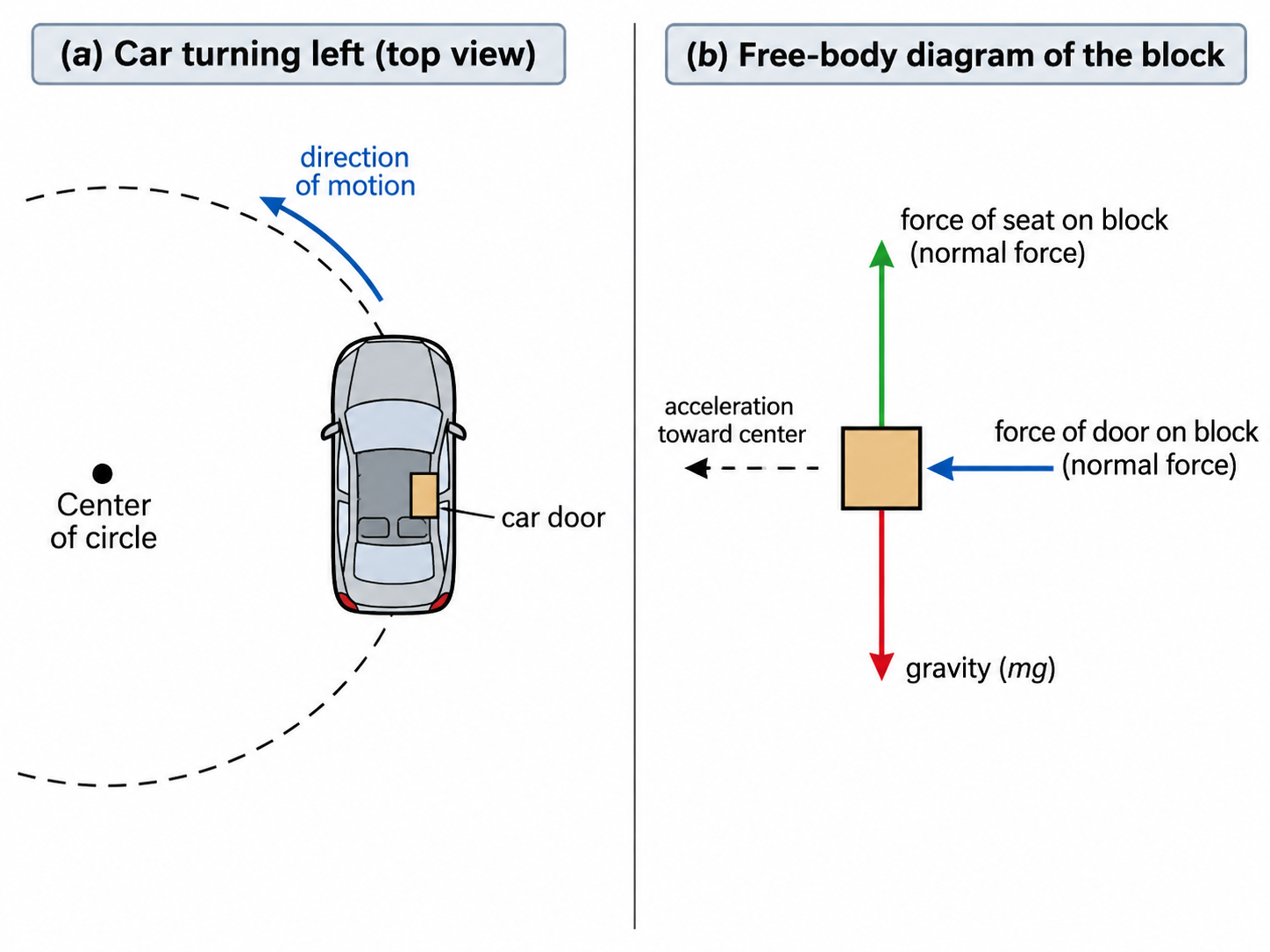
Note that these two pictures are a little confusing in that they are rotated relative to each other. In the left picture, the arrow for gravity would be going directly into the page, whereas in the right picture gravity points down. 3D is hard.
The “trick” is that this block is sitting in the passenger seat of a car that’s driving in a circle. In the frame of reference of the car, this block isn’t accelerating - it stays seated in the passenger seat. But if you zoom out and look at what’s really going on, the block is constantly accelerating (towards the center of the circle).
Now that you know what’s really going on, you’re no longer tempted to add the “missing force” arrow to make things balanced. Instead, you’re happy to accept the conclusion “the block is accelerating”.
But imagine you lived your whole life inside that car. In fact, you didn’t even know you were inside a car. You just thought that’s what the universe looked like and it never occurred to you that maybe there was something bigger and that what you considered “the universe” was just a tiny little car inside a much bigger universe. Let’s call this perspective “car-land”.
If that was your frame of reference, you’d be back to thinking “No, the block really isn’t moving!” and you’d be quite tempted to add the missing force in order to make the world make sense again. Let’s call this missing force the “centrifugal force”.
Once we know about the car, we call this “missing force” a fictitious force because, well, it’s not really there. We know what’s really going on.
The first similarity
I’d like to point out our first similarity between this mysterious “centrifugal force” and “gravity”.
People who live in car-land notice that the car door is constantly pushing on them, and yet they don’t move! In order to make sense of this fact, they posit the existence of an ever-present force pushing them to the right and they name it “the centrifugal force”.
People who live on Earth notice that the ground is constantly pushing on them, and yet they don’t move! In order to make sense of this fact, they posit the existence of an ever-present force pushing them towards the ground and they name it “gravity”.
But maybe, just maybe, that perspective is missing what’s really going on.
How hard does the centrifugal force push?
The next thing our inhabitants of car-land do is attempt to quantify how hard the centrifugal force pushes on different objects.
They come up with the following formula:
\[F = \left(1.58\ \mathrm{m/s^2}\right)m\](Exercise for the reader: assume the car is traveling in a circle of radius 100 m. How many seconds does it take for a full revolution?)
The second similarity
People who live in car-land notice that the centrifugal force is proportional to mass. This results in the following really neat science experiment that they love demonstrating to young children: First, create a vacuum. Then let go of a feather and a bowling ball at the same time. They hit the car door at exactly the same time! How strange is that? Most kids think the bowling ball will hit the car door first.
People who live on Earth notice that the force of gravity is proportional to mass. This results in the following really neat science experiment that they love demonstrating to young children: First, create a vacuum. Then let go of a feather and a bowling ball at the same time. They hit the ground at exactly the same time! How strange is that? Most kids think the bowling ball will hit the ground first.
What do straight lines look like?
Let’s analyze the feather and bowling ball experiment in car-land, but from our outside perspective. We know that there is no such thing as the centrifugal force; it’s a fake (fictitious) force that car-landians needed to invent in order to make sense of the world from their perspective. What’s really going on?
When the feather and bowling ball are let go, they continue traveling straight (tangent to the car’s motion at the moment they are let go). But the car continues turning and so, from the perspective of car-land, it looks as if the bowling ball and the feather accelerate toward the car door.
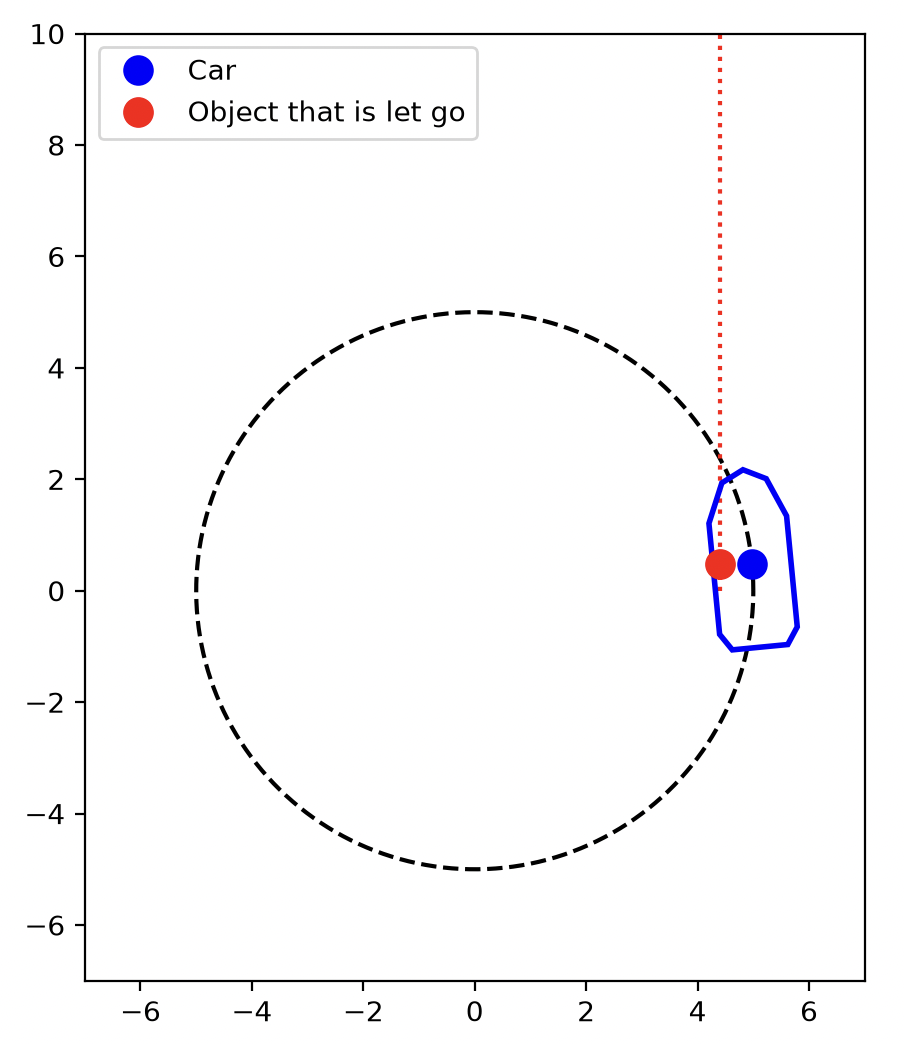
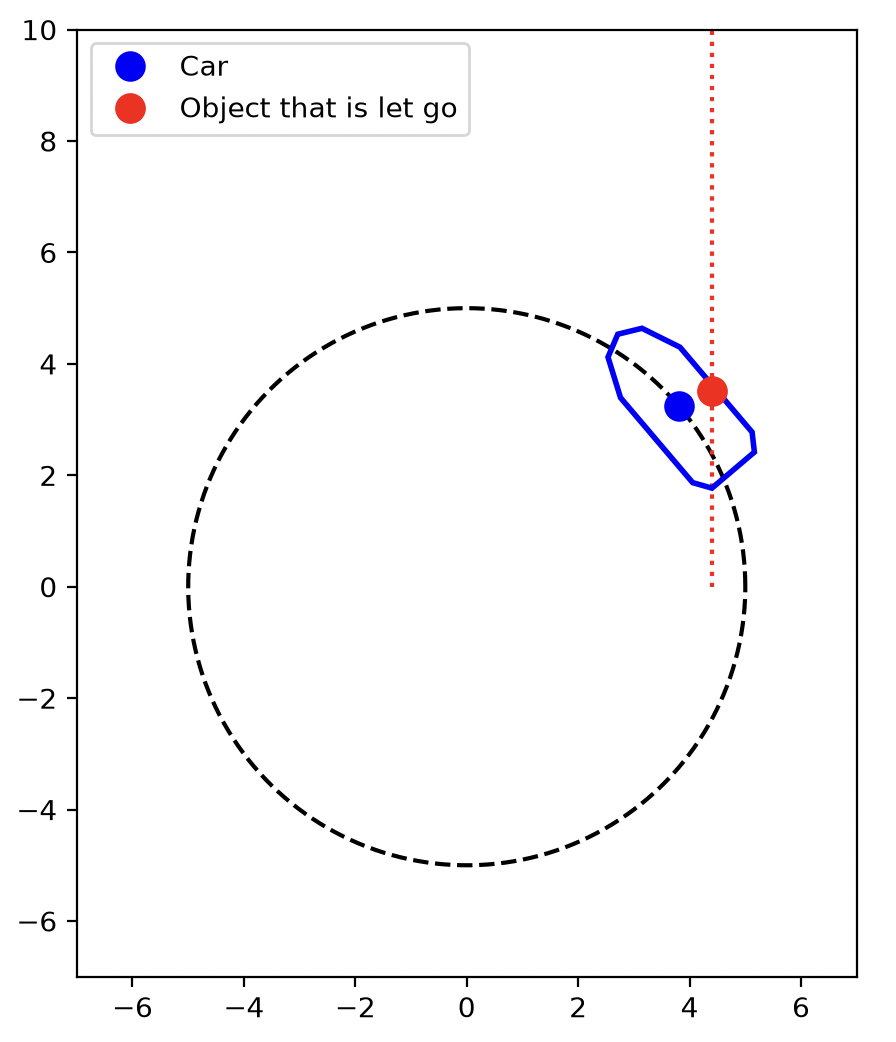
But from the perspective of the blue dot, this is what this straight-line trajectory looks like:
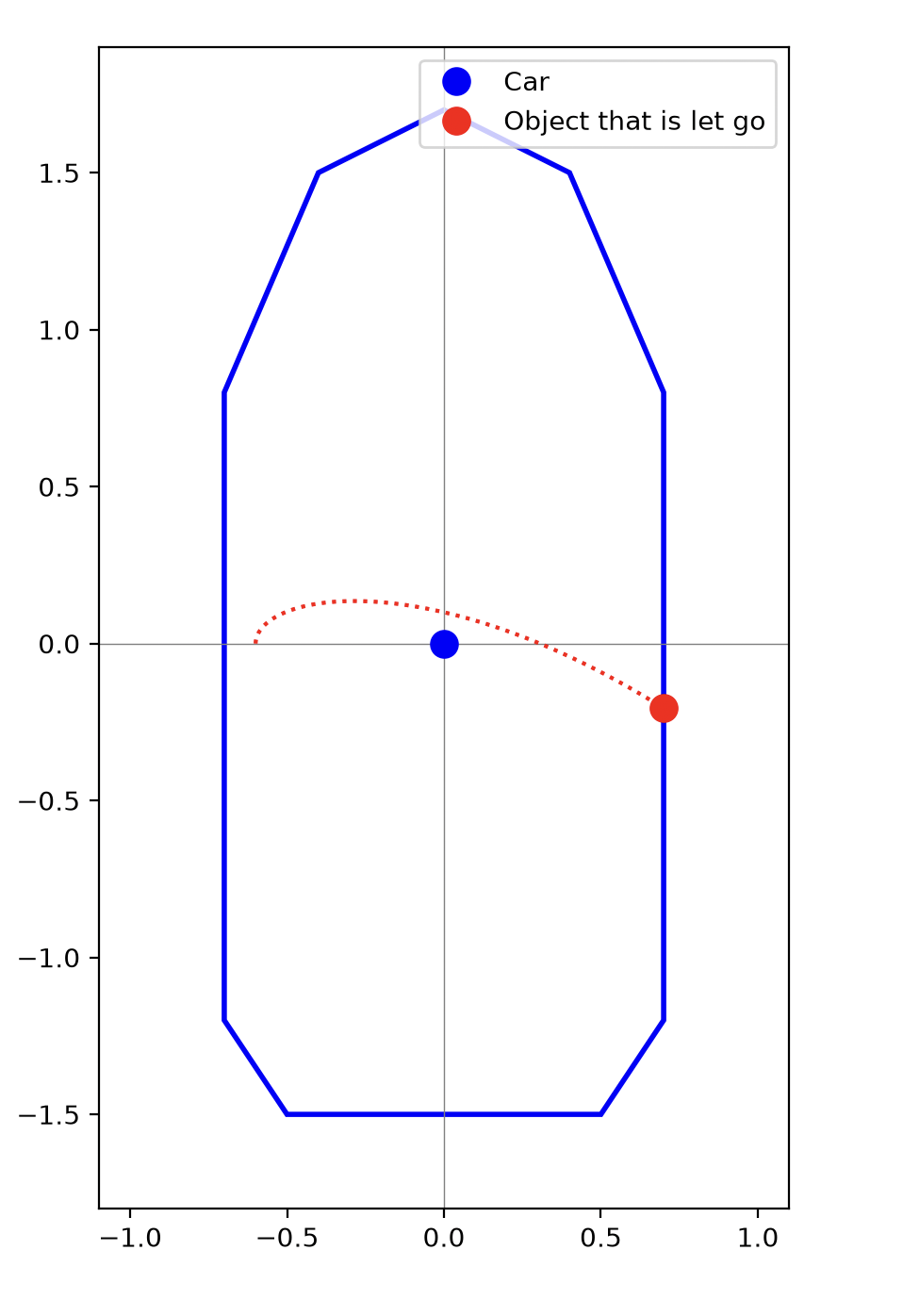
The feather (or bowling ball) seems to make this strange spiral-ish motion and eventually hit the car door. Importantly, the feather and bowling ball follow the exact same trajectory.
Why do the feather and bowling ball follow the same trajectory?
From the perspective of car-land, it seems like “the centrifugal force is proportional to mass, and so mass cancels out when solving for acceleration”. From the outside perspective, a more accurate representation is “both objects travel in a straight line with the same initial velocity and no horizontal forces acting upon them (until they hit the car door)”.
Once they do hit the car door, the car door really does exert a greater force on the bowling ball than the feather in order to change its velocity. It needs to change their velocities by the same amount (in order to keep them inside the car) and the bowling ball has a larger mass - so it needs a greater force. The force of the car door really is proportional to mass.
From the car-land’s perspective, the reason why the car door has to push harder on more massive objects is to counteract the ever-present centrifugal force, which is proportional to mass. But from the outside perspective, it’s because the car door needs to accelerate heavier and lighter objects by the same amount, and in order to accelerate an object that’s twice as massive, you need to push twice as hard.
The second similarity, revisited
When people on Earth drop a bowling ball and a feather in a vacuum, they accelerate at the same rate and hit the ground at the same time. We attribute this fact to gravity. In particular, we attribute it to the (slightly suspicious) fact that the force of gravity is proportional to mass and so it cancels out when you solve for acceleration.
But what if there’s some other “outside perspective” that views things differently? What if there is no such thing as gravity? What if what we see as gravity is actually a consequence of the fact that we’re accelerating and just don’t realize it? When we drop the feather and the bowling ball, they travel in a straight line. From our (accelerating) perspective, this looks like downward acceleration. But from another perspective, it looks like straight-line motion while we accelerate up towards them.
Why are we accelerating? The ground, of course! We can feel the force of the ground pushing on us. And the ground really does push harder on more massive objects. So the ground constantly pushes up on us, accelerating us up towards free-“falling” objects.
I thought this post was about General Relativity. What is it?
Einstein’s theory of General Relativity makes the claim that gravity is a “fictitious force” and that things that look like they are accelerating due to gravity are actually traveling in a straight line from some outside perspective.
By using the analogy of a car driving in a circle, we can gain some intuition for how this can possibly be true. However, the analogy is not perfect. In the car analogy, the explanation is that the reference frame of the car is accelerating. In general relativity, the thing that causes straight lines to appear curved is something about the curvature of “space-time” (which is a four-dimensional object). Maybe it’s just me, but I find the “car driving in a circle” analogy quite a bit easier to wrap my head around.
The best analogy I can think of for “the curvature of space-time” is a racetrack with very curved (banked) turns. Notice in the picture below that the angle of the racetrack increases the farther you get from the inner edge.

If you imagine driving a race car into the turn, even if you never turn the wheel, the car will turn (somewhat) because of the curvature of the banked turns on the racetrack. Let’s call that path the “straight-line” path since we never turned the steering wheel. The “straight line path” looks curved, and it’s due to the underlying curvature of space (the road, in this case).
But before you start thinking “oh, yeah that kind of makes sense”, remember that the thing that is curved is space-time itself. If it was just space that was curved, I think maybe I could wrap my head around that. But it’s space-_time_ that’s curved. Maybe someday.